20 March 2026 · Bruce · 12 min read
prospecting-techniquesThe Five Reasons You're Still Finding Nothing
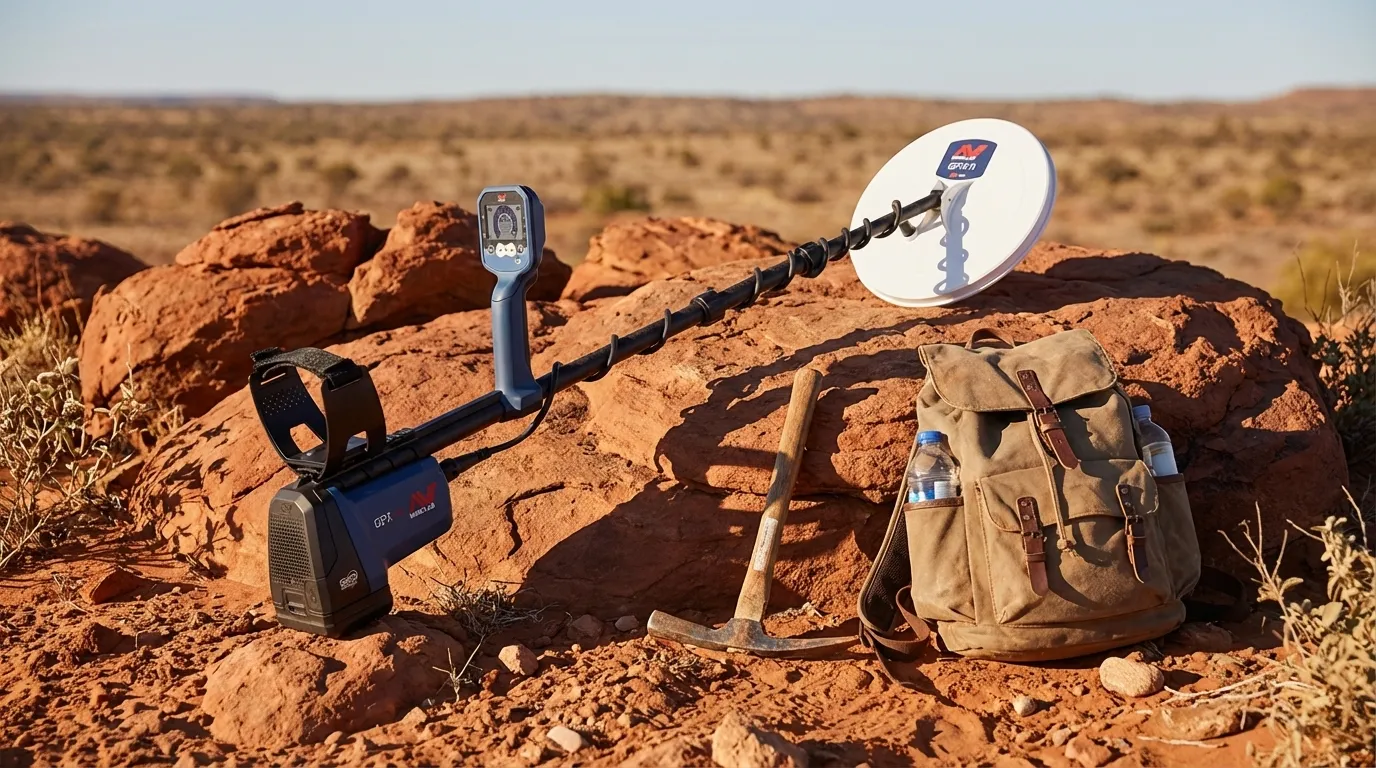
Gold is being found in the WA Goldfields every single weekend.
Not by the same lucky people. By the same skilled people. There's a small group of recreational prospectors who consistently fill their pouches while everyone around them drives home empty, and they're not running better equipment, they're not working secret ground, and they're definitely not luckier. They've just closed a skill gap that most beginners don't even know exists.
Here's the brutal version of that: if you've done three or more trips and found nothing, luck stopped being a credible explanation after the first one. You have a diagnostic problem. Something specific is working against you — probably several things — and until you identify what they are, you'll keep producing the same result.
I've spent thirty years doing exploration geology across WA's Goldfields. I've also spent the last several years watching recreational prospectors work, which is a different kind of education. What follows isn't a list of tips. It's a diagnosis. Read it like one.
Mistake 1: You Chose Your Location Like a Tourist
I want to say something plainly, because the prospecting community dances around it: most ground in WA will never produce gold, no matter how long you detect it or how good your technique is.
Gold in WA is not scattered across the landscape waiting to be found. It exists in specific geological environments — ancient Archean greenstone belts formed three billion years ago, running in corridors through the Eastern Goldfields, the Murchison, and the Pilbara. These greenstone terrains are where WA's gold lives. The granite country between them, the Permian sedimentary basins, the broad lateritic plains — detecting those environments isn't unlucky. It's geologically uninformed.
The greenstone belts aren't subtle on a map. They're documented, named, and extensively recorded. But beginners don't check. They choose locations based on driving distance, YouTube footage, or a mate's vague recommendation — none of which tells them a single useful thing about what's in the ground.
Before your next trip, spend thirty minutes on MINEDEX or GoldProspectingWA.com and look up the documented production history of your target area. You're looking for recorded alluvial workings, historical soil sample anomalies, or drilling intercepts within a few kilometres of where you plan to detect. Any of those tells you gold has been confirmed in that ground. The absence of all of them tells you something equally important, and you should listen to it.
There's a specific trap worth naming here. Beginners are consistently drawn to remote, untouched-looking country — the assumption being that isolation implies undiscovered gold. It's an understandable instinct. It's also wrong. WA's goldfields were walked over by tens of thousands of experienced, highly motivated men during the 1890s rush. Men who covered extraordinary distances on foot and knew exactly what they were looking for. Country that was going to produce got found. The genuine opportunity for modern prospectors isn't virgin ground — it's documented productive ground that's never been properly worked with a PI detector capable of finding sub-gram gold at depth. That's a real and findable thing. But it requires knowing where to look before you leave the house.
Mistake 2: You're Detecting the Right Region in All the Wrong Places
Even inside a proven goldfield, you can spend an entire day on ground that will never produce anything. Gold doesn't distribute itself evenly across a region and wait to be stumbled across. It concentrates, funneled by geology into specific structural positions that repeat in predictable ways across every productive goldfield in WA.
The key positions: shear zones, where crustal movement has crushed and mobilised rock and created chemical traps; contact boundaries between greenstones and intrusive granites or dolerites, where gold is precipitated out of hydrothermal fluids; the margins of quartz reefs, particularly where reef geometry changes — bends, jogs, pinches; and calcrete horizons, the pale hardpan layer you find across much of the Goldfields, which acts as both a physical barrier that traps downward-moving gold and a chemical environment that concentrates it. If you've never deliberately detected around calcrete breakaways and the exposed bedrock beneath eroded calcrete, that's a gap worth filling.
When you arrive at a new location, put the detector back in the bag for ten minutes and walk. Look at what the rock is telling you. Dark, fine-grained greenstone — the kind that looks almost black when it's wet — is the host rock you want to be working around. Pale granite and red sandstone are generally far less interesting. Find the quartz: veins cutting through the host rock, particularly any showing rusty orange-red staining. That's oxidised sulphide mineralisation. Sulphides — pyrite, arsenopyrite, pyrrhotite — are gold's most consistent chemical companions in WA. Rusty quartz in greenstone terrain is not a guarantee, but it's as close to a reliable indicator as the surface gives you. Mark those zones on your phone and start there.
One thing that consistently strikes me watching beginners work: they almost always default to the most comfortable terrain — flat, open, sandy ground where the coil glides cleanly and the walking is easy. That ground is almost always transported alluvial material that has moved a long way from its source. The source is somewhere upslope. The productive ground is rough, rocky, uneven, up against the laterite breakaways and the exposed bedrock contacts. It's harder work. The gold doesn't care about that.
Mistake 3: Your Coil Is Flying
Here's something the detector manufacturers won't put on the box: the difference in detection performance between a half-gram nugget at eight centimetres and the same nugget at twelve centimetres is not linear. On WA's hot, mineralised soils, that four-centimetre difference — caused entirely by carrying the coil too high — can mean the difference between a clear signal and nothing at all.
A half-gram piece at ten centimetres on a modern PI detector might produce a single faint flutter in the threshold tone, a whisper that lasts less than a second at slow walking pace. Speed the swing up or bounce the coil fifteen centimetres off the ground, and that whisper becomes inaudible. Not because the detector can't find it. Because you didn't give it the conditions to.
The technique fix is simple and uncomfortable in equal measure: whatever pace you currently work at, halve it. Overlap each sweep by at least fifty percent. Keep the coil as close to the surface as the terrain allows — on rough ground, tilt the leading edge slightly down on the upswing rather than lifting over obstacles. Maintaining close proximity to the ground matters more than a clean swing path.
The sensitivity question deserves its own mention, because most beginners get it precisely backwards. They crank sensitivity to maximum on the assumption that higher means deeper. On WA's ironstone-rich, mineralised soils, what maximum sensitivity mostly produces is noise — random chattering and phantom signals that has no relationship to any actual metal target. Here's what that noise costs you: every false signal you stop to dig is time and focus spent on nothing. More importantly, it degrades your ability to recognise what a genuine signal actually sounds like. A noisy machine trains you to ignore signals. That's the opposite of what you need. Ground balance properly, bring sensitivity back until the machine runs stable and quiet, and trust the threshold. A calm detector moving slowly is detecting properly. A noisy detector moving fast is detecting nothing properly.
Mistake 4: You're Walking Past the Best Map You'll Ever Find
Every shaft sunk in the WA Goldfields represents a decision: someone concluded that the gold in this precise spot was worth extracting by hand, with picks and shovels and wheelbarrows, in summer heat, without machinery or shade or any certainty of what was below. The old-timers were not random. They were systematic, experienced, and motivated by necessity in a way that is genuinely hard to imagine. Their workings are not obstacles or hazards to work around. They are evidence — the most reliable surface evidence of gold occurrence you will encounter in the field.
But the individual shaft location is almost the least useful thing old workings offer. The useful thing is pattern.
A line of shafts running northeast tells you the orientation of the gold-bearing structure and exactly which direction to extend your search. A spread of shallow costean trenches across a flat tells you alluvial gold was widespread through that ground at surface — which means the deeper material below the old working horizon almost certainly holds what they couldn't retrieve without a detector. A single deep shaft with a substantial mullock heap tells you someone hit something worth following down, and the margins of that shaft are exactly where fine gold lands when it's excavated and thrown.
Detect the lips and edges of old workings from the surface — never lean over an open shaft, because old timber doesn't age well. Detect the mullock heaps themselves; fine gold was routinely discarded with waste rock because it was invisible or unrecoverable with 1890s methods. Then search methodically beyond the last visible working in the direction the pattern indicates the reef was running. Old prospectors stopped at claim boundaries, or when the visible surface expression disappeared — not because the gold ran out, but because their authority to dig ran out, or their visibility into where to go next ran out.
Here's the harder truth about heavily detected ground: the obvious stuff around well-known old workings has been covered many times. What hasn't been covered — what almost nobody does — is systematic work on the extensions. Fifty metres past the last shaft, in the direction the geology suggests. A hundred metres uphill from the shallow alluvial scratchings, toward the source. The perimeter beyond where the previous prospector stopped. That ground has often never been properly worked. It just requires committing to a theory about where the gold went, rather than detecting whatever's easy and convenient.
Mistake 5: You're Treating Prospecting Like a Lottery
This is the one that sits underneath all the others.
Watch a beginner's day in the field and you'll see the same pattern play out: forty-five minutes at the first spot, nothing found, drive to the next. Another hour, nothing, drive again. By lunchtime, five different areas have been partially covered and nothing meaningful has been learned about any of them. By the afternoon, it's starting to feel like bad luck.
It isn't. It's a methodology that was never going to work, applied repeatedly and confirmed as failure each time.
Beginners treat prospecting like a lottery. The implicit theory is that if you move around enough, if you cover enough different ground, the random distribution of gold will eventually put a nugget under the coil. This theory feels reasonable. It is completely wrong, and it ensures that the only gold you'll ever find is by genuine accident.
Experienced prospectors treat it like a systematic search problem. Fewer locations, worked more thoroughly, with notes kept on every session — what the ground looked like, what the rock was doing, where the signals were, what you found and what you didn't. That record, built across a season of weekends, is worth more than any detector upgrade you could make. It's the difference between accumulating knowledge and accumulating kilometres.
When you find your first piece of gold — and you will, if you apply the other four points on this list — the instinct is to grid that exact spot and expect more from the same hole. Resist it. Gold travels. Small nuggets roll downslope, get carried by erosion, collect in depressions. The piece you found has moved from somewhere. Search uphill and upslope from the find. Work back toward the source material. If the geology is right, the ground that produced one piece will produce more — not in the same hole, but in the same corridor, following the same structure.
Give any genuinely prospective location a minimum of two to three hours of focused, methodical work before you move on. Not two hours of random swinging — two hours of systematic grids, marked on your phone, so you know precisely what ground you've covered and what you haven't. When you leave without finding anything, you're not confirming that the spot is no good. You're confirming that your coverage of that spot didn't produce on that day. Those are very different conclusions, and the second one gives you a reason to come back.
The Actual Difference
The prospectors finding gold every other weekend aren't luckier than you, and most of them aren't running better gear. They've simply closed the gap between guessing and knowing. They choose ground that has documented production history. They understand what the geology is telling them before they put the coil down. They work slowly and methodically enough to hear what the detector is actually saying. They read old workings as evidence rather than scenery. And they treat a location as a systematic search problem rather than a place to check off and leave.
Every one of those is learnable. None of them require spending another dollar.
The place to start is before you leave home — with the right information about where gold has actually been confirmed in the ground you're planning to work. That's what GoldProspectingWA.com is built for: daily-updated tenement maps, historical soil sample data, and drilling results across the WA Goldfields, so your next trip begins with knowledge rather than optimism.
Gold is out there. The question is whether you're making decisions that give you a real chance of finding it.
Bruce is an ex-exploration geologist and has been prospecting for gold for thirty years and the founder of GoldProspectingWA.com.