9 July 2026 · Bruce Hearder · 14 min read
location-researchThe Rise and Fall of Mt Palmer: Western Australia's Short-Lived Gold Boom in the Yilgarn
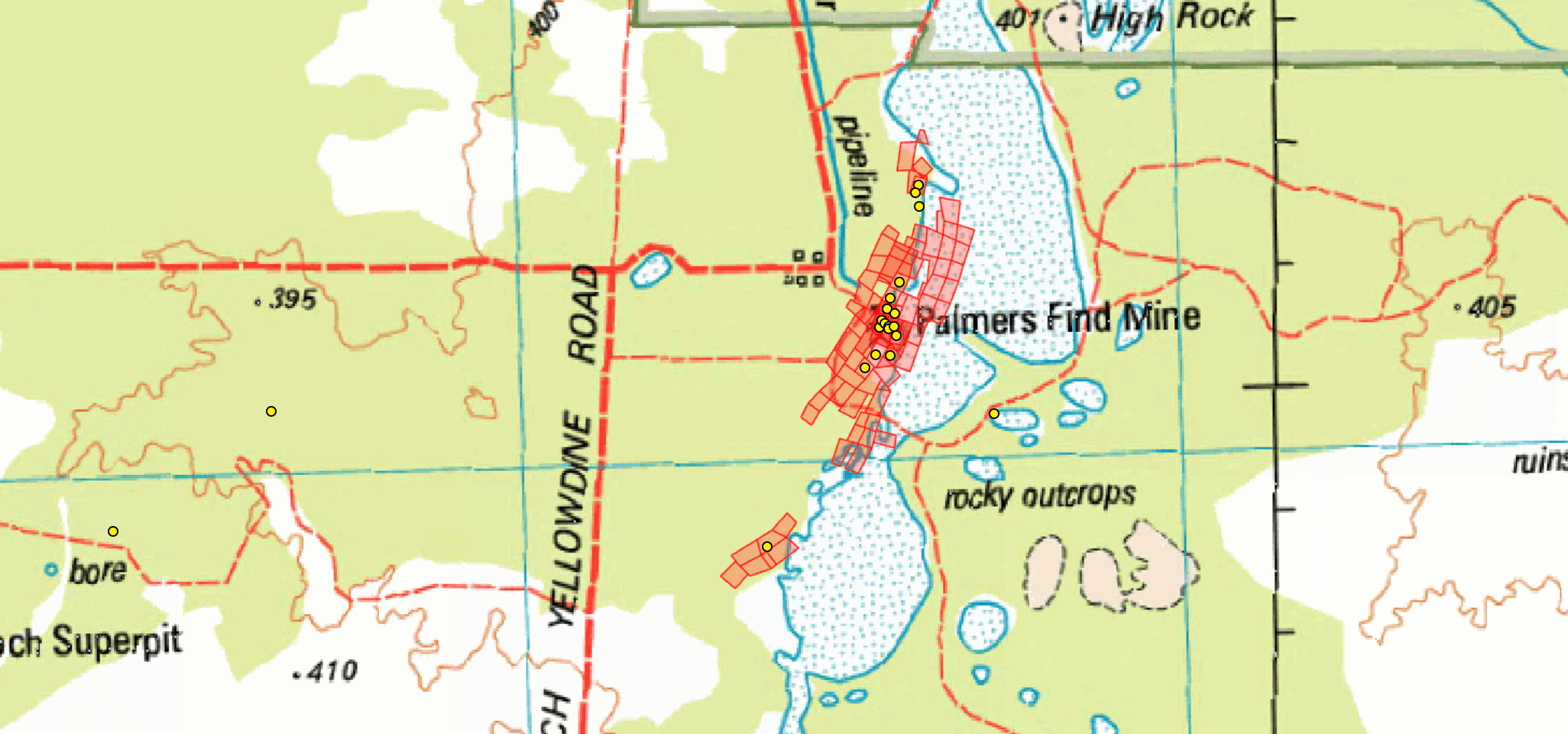
Drive east out of Southern Cross on a still winter morning and the country opens up into that classic Yilgarn scenery — low salmon gums, granite breakaways, and the pale glare of a salt pan shimmering on the horizon. There's nothing out here now to tell you that a town of five hundred people once stood on this ground, that three hotels once pulled beers for thirsty miners, that a two-up ring once rattled coins under a corrugated-iron lean-to. But it was all here. For a single decade, Mt Palmer was one of the liveliest little goldfields in Western Australia. Then, almost as quickly as it appeared, it was gone.
If you've spent any time chasing gold or history around the Eastern Goldfields, you'll know Mt Palmer's story is really the story of the whole state in miniature. A rich find, a frantic rush, a proper little town with a survey and a name, a mine that paid extraordinary returns — and then war, labour shortages, and a played-out reef, and the whole thing folds up and blows away with the red dust. In this post I want to walk through the lot: how the gold was found, what the mine and the town were actually like, why it died, and — for those of you keen to go and stand on the ground yourself — exactly what you need to know about getting there and, crucially, why you can't just wander in and swing a detector. Because that part matters, and it's changed as recently as this year.
The discovery of gold at Mt Palmer
By the standards of the Western Australian goldfields, Mt Palmer was a late bloomer. The great rushes at Coolgardie and Kalgoorlie belonged to the 1890s, forty years earlier. By the mid-1930s, most prospectors reckoned the easy ground around the Southern Cross district had long since been picked over. The Great Depression had pushed a lot of men back out bush with a pan and a dolly pot, because a few grains of gold was better than no work at all — and that pressure of hard times is exactly what put boots back onto old country.
In late 1934, an experienced prospector named Augustus Palmer — known to everyone as "Daddy" Palmer — was working south of Yellowdine with his partners W. Colhoun and A. Pollard. They were doing it the old way, out with a horse and cart on a prospecting expedition through unfashionable ground, and south of Yellowdine they hit gold. Word of a good find travels fast in the bush, and the place quickly picked up the obvious name: Palmer's Find.
What started as alluvial and shallow work didn't stay small for long. As the leases proved up, the loose scatter of individual prospectors gave way to syndicates with the capital to sink shafts and chase the reef down into hard rock. That's the pattern all over the goldfields — one man finds the colour, and the money follows to dig it out properly. Leases were pegged in a hurry. From maybe two hundred men on the ground in late 1934, the population climbed toward five hundred through 1935 as miners, families, and the usual crowd of storekeepers, publicans and hangers-on poured in.
A camp that size, thrown together out of humpies and tents, becomes a public-health problem fast. Typhoid was the great fear of every goldfields camp, and the rough living conditions at Palmer's Find had the government worried enough to act. A townsite was surveyed and gazetted in 1935, and town blocks were put up for auction over in Southern Cross. There was a bit of to-and-fro over the name — Palmer, Palmerdale and Palmerston were all floated and knocked back — before the authorities settled on Mount Palmer. Daddy Palmer got his hill, if not quite his town.
The mining boom and operations
Alluvial gold is where a field starts, but it's never where the real money is. The making of Mt Palmer was the hard-rock reef, and the man who backed it was Claude de Bernales — one of the great, and occasionally controversial, promoters of the Western Australian mining scene. In 1935 a 20-head stamp battery was commenced to crush the ore, and once that plant was thumping away, Mt Palmer turned from a rush into a genuine producer.
The numbers from the peak years are eye-watering for a field most people have never heard of. By 1937 the mine had crushed around 85,000 tons of ore and pulled roughly £470,000 worth of gold out of it, employing about 130 men at its height. Investors did extraordinarily well — something on the order of £200,000 returned in the first two years alone, which in 1930s money was a serious fortune. Over the full life of the operation, official production came in at about 4,928 kilograms of gold — that's better than 158,000 ounces — recovered from around 310,728 tons of ore. Do the math and you land on an average grade near 15.9 grams per tonne, which is a genuinely high-grade orebody. Anything into double digits gets a modern geologist's attention; sixteen grams to the tonne is the kind of dirt that builds towns. The main shaft was sunk to around 500 feet, and as always with the old fields there's persistent talk that the true recovered yield was higher than the books ever showed.
Geologically, none of this is a surprise once you know the country. Mt Palmer sits in a greenstone belt — the same broad class of ancient rock that hosts nearly all the great Yilgarn goldfields. The gold occurs in quartz reefs cutting through mafic volcanic rocks, the classic Archaean lode setting you'll find echoed from Southern Cross to Kalgoorlie. If you've read a few WAMEX reports for this district, the language will be familiar: shear-hosted quartz veining in a mafic-dominated greenstone sequence. It's textbook Yilgarn, and it paid like it.
The town that grew up around all this was no rough scatter of tents by the end. Mt Palmer had three hotels, and one of them was a two-storey affair with a long bar that was described in its day as one of the most pretentious pubs in the Goldfields — quite a claim in a region that never went short of grand hotels. There was a bakery, a butcher, boarding houses, and of course the two-up rings where a week's pay could change hands in an evening. The workforce was a real mix. Some were career hard-rock miners; others were local farmers who'd taken up mine work, a number of them under the provisions of the Miners' Phthisis Act, the legislation dealing with the lung disease that dogged men who breathed rock dust for a living. It was, in other words, a proper community — the kind of place where families lived, kids went to school, and Saturday night meant something.
The demise and abandonment
Here's the hard truth about a single-mine town: it lives and dies with the mine, and it has no second act. Mt Palmer's decline, when it came, was quick and more or less total.
The first blow was the Second World War. When the men enlisted, the mines emptied. Gold mining was not a protected occupation in the way that feeding the war effort was, and Mt Palmer's workforce bled away — down to about sixty men by the end of 1942, from a peak of well over a hundred. At the same time, costs were rising and the richest ore was running out. A high-grade reef is a wonderful thing, but it's a finite one, and after the better part of a decade the easy tonnes at good grade were largely gone.
Put those two pressures together — no men and thinning ore — and the outcome was never really in doubt. By the end of 1943 Mt Palmer was already most of the way to being a ghost town. The mine finally closed in June 1944, after roughly nine or ten years of production. With the mine gone, there was no reason for the town to exist, and it was abandoned almost immediately.
What happened next is a very Western Australian coda. In 1947 the grand two-storey hotel was demolished, and its bricks were carted off and reused in Kalgoorlie — the town quite literally dismantled and recycled into somewhere with a future. A scatter of foundations, tanks and rubble was left to the salt pan and the salmon gums. Mt Palmer's whole arc, discovery to abandonment, had run its course in barely a decade, and it stands now as a neat, sobering example of what war and geology together can do to a remote mining community.
Visiting Mt Palmer today — access, challenges, and practicalities
For anyone with an interest in goldfields history, Mt Palmer is a genuinely rewarding place to stand. There's a surprising amount still visible: the foundations of the mine buildings and treatment plant, the old cyanide tanks, the water dams, and — the photo everyone comes for — the surviving archway of that grand demolished hotel, framing empty sky. It sits out near the Yellowdine salt pan in the Shire of Yilgarn, and on a quiet morning it's a properly atmospheric spot.
But — and this is the part I need you to read carefully — you cannot treat Mt Palmer as open ground.
Tenements and access restrictions. This is live, held country. The Mt Palmer project is covered by active mining tenements, and ownership has changed hands more than once in recent years, so it pays to be current. Through the mid-2020s it sat in a joint venture between Kula Gold and Aurumin, with Kula earning up to 80% of the project. Then in January 2026 Forrestania Resources took over Kula Gold, picking up that 80% interest, and shortly after acquired the remaining 20% from Newcam Minerals — so as of 2026 Forrestania Resources holds 100% of the Mt Palmer gold project, and there's active exploration and drilling going on. What that means for you on the ground is simple: this is somebody's working tenement. You are not permitted to enter active or fenced mine areas without written permission from the tenement holder, you must obey all signage, and there is to be no unauthorised fossicking or prospecting on the leases. That's not me being precious — it's a working exploration site with genuine hazards, and it's the law.
Take the open shafts seriously. The single most dangerous thing about any old goldfield is the ground itself. Mt Palmer has open shafts, costeans, and stopes that can be collapsed, hidden by scrub, or a long way straight down. Unstable ground and rotten timber don't announce themselves. Stay on firm surface, keep well back from any collar or depression, and for heaven's sake keep kids and dogs close. A historic site is worth seeing; it is not worth falling into.
How to get there. Mt Palmer is roughly 415 km east of Perth and about 46 km south to south-east of Southern Cross, out near Yellowdine. The run for most people is the Great Eastern Highway to either Southern Cross or the Yellowdine Roadhouse, and then off the bitumen onto unsealed gravel and sandy tracks — the Mt Palmer Track being the usual approach. A high-clearance 4WD is the sensible minimum. After rain those tracks turn to bogholes and slick mud, and this is not country where you want to be stuck on your own. Treat any directions you read online — including mine — as a general guide only, and check current road and track conditions locally before you commit, because they change with every wet season and every bit of station or mining activity.
Camping and accommodation. There's a designated camping area near the old townsite, and outside the school holidays and the peak winter run it's often beautifully quiet. If you'd rather have a few more comforts, Southern Cross is the obvious base. The Southern Cross Caravan Park sits right on the Great Eastern Highway and offers powered and drive-through sites, tent sites, cabins and motel rooms, a camp kitchen, ablutions and a laundromat, and it's pet-friendly under the usual conditions. There are other camping spots scattered through the broader Yilgarn region too if you're building a bigger trip around it.
What to bring, and when to go. Go in the cooler months — autumn through early spring — and avoid the summer, when the heat out here is no joke and the salt-lake country is unforgiving. Carry far more water than you think you need, real recovery gear, a means of communication that doesn't rely on mobile coverage, and let someone know your plans before you leave the bitumen. Come at Mt Palmer as a photography-and-heritage trip — relics, foundations, that hotel archway against the sky — rather than a detecting one, and you'll get the best of the place while staying on the right side of both the law and common sense.
Interesting side stories and human tales
Strip away the tonnage figures and the tenement history and what's left is people, and Mt Palmer has a few human threads worth pulling.
One that's stuck in the local record is the tale of John Ebenezer Jones, who died at Mt Palmer aged seventy, not long after the field was discovered. The story — preserved in local family-history writing — turns on a small, oddly touching detail of frontier life: a kind of competition around his burial, in a brand-new camp that didn't yet have much in the way of ceremony or a proper cemetery. It's the sort of story that reminds you these were real settlements where people not only worked and drank and gambled, but grew old and died, all inside the span of a few short years.
Then there's the grand hotel again — that two-storey pub with the long bar, reckoned one of the most pretentious in the Goldfields. There's something almost poetic in its ending: too fine to leave standing in a dead town, valuable enough to pull apart, its bricks trucked off to build in Kalgoorlie. The best building on the field outlived the field itself, just somewhere else.
And there's the texture of the workforce — the local farmers who came off the land to mine, some under the Miners' Phthisis Act, working alongside the career hard-rock men; the typhoid worry that pushed the government to survey a townsite in the first place; the auction of town blocks in Southern Cross that turned a tent camp into a gazetted town almost overnight; the two-up rings where the week's cheque was won and lost. Put together, they sketch a boomtown that packed a full human lifecycle into ten years.
Mt Palmer only lasted a decade, but it earns its place in the Western Australian goldfields story precisely because it's so complete. In ten years it ran the entire cycle — a chance find by an old prospector working unfashionable ground, a rush, a surveyed town with hotels and a school and its own name, a mine that paid handsomely off genuinely high-grade reef, and then a fast, total collapse under the weight of war and a played-out orebody. If you want to understand the boom-and-bust rhythm that built and emptied a hundred WA settlements, you could hardly find a tidier example.
If you go — and it's well worth going — go respectfully. The ground is live tenement held today by Forrestania Resources, the shafts are genuinely dangerous, and the relics are a shared heritage that survives only as long as people treat it decently. Get your permissions right, obey the signage, keep clear of the old workings, and spend your money in Southern Cross and the Yilgarn while you're at it — that's how these historic goldfields stay accessible for the next lot of curious travellers. Stand under that hotel archway with the salt pan behind you, and you'll feel the whole thing: the boom, the bust, and the long quiet afterward. That's the goldfields in a nutshell, and Mt Palmer tells it as well as anywhere.
Former exploration geologist with 10 years of professional gold exploration in Western Australia and nearly 35 years as a recreational prospector. Read his full story →